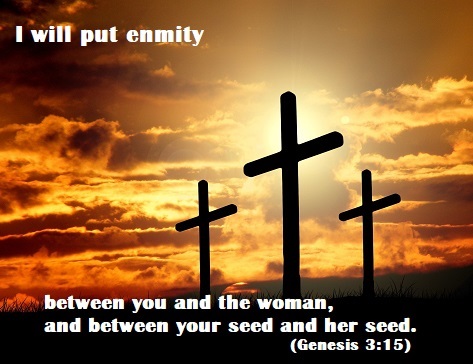
The Estuary of Theology 14 I Will Put Enmity The discussion in the previous issue shows that even though the “my church” (cf. Matthew 16:18, The Estuary of Theology issue 8 ), which has the role and the vocation of the Holy Family, had bruised the head of the serpent , its effect has been postponed as the result of the fulfilment of God’s foretelling, “ [Y]ou shall bruise his heel ” (cf. Genesis 3:15). Therefore, the fulfilment of this foretelling is supposed to have happened after the “my church” was established through Pentecost. In this case, “his heel” indicates the heel of the “my church,” which was established by the Holy Spirit, who makes Jesus’ spirit present, while “you” indicates the information of the “serpent,” which has been existing since the man had become two persons, the man and the woman (cf. The Estuary of theology issue 11 ). In this issue I would like to discuss again the work of the information of the “serpent,” which makes people like Satan (the devi...
Posts
- Get link
- X
- Other Apps
The Estuary of Theology 13 The Work of Man (The Head of the Serpent) For God, Cain was the firstborn who was the fulfilment of His word, “ Be fruitful and multiply, and fill the earth and subdue it ” (Genesis 1:28). It is easy to infer how God was looking forward to Cain’s birth. However, Cain was born to the parents who had become like Satan (the devil) and had lived based on the information of the serpent (cf. The Estuary of Theology issue 12 ), and he was brought up by them. Soon Abel, his brother, was born and became a keeper of sheep, and Cain became a tiller of the ground. However, Cain’s work was hard because “ cursed is the ground ” (Genesis 3:17) by the acts of his parents. This was his burden. He succeeded not only his body but also the result of the error from his parents. According to the discussion last time, we can say Cain had three lords: the Father, who had given a name to his mother regarding her as “the mother of all living” and ruled her; the mother, wh...
- Get link
- X
- Other Apps
The Estuary of Theology 12 The Work of Man (Satan, the Devil) “ The man called his wife's name Eve, because she was the mother of all living ” (Genesis 3:20). The fact that the man gave a name to the woman has become the direct cause of the deportation of the man from the garden of Eden. The two, who were both virgins at that time (cf. The Estuary of Theology issue 5 ), could not understand the following word of God: “ I will greatly multiply your pain in childbearing; in pain you shall bring forth children, yet your desire shall be for your husband, and he shall rule over you ” (Genesis 3:16). The man fulfilled the word, “ he shall rule over you ,” by calling “ his wife's name Eve .” He showed off the authority of ruling the woman before God. The action of the man of having given a name to his wife like man , who had given names to the living things (cf. Genesis 2:19) , ignores the command of God given to the two, who had made humans male and female from the beginnin...
- Get link
- X
- Other Apps
The Estuary of Theology 11 The Work of Man (The Serpent) (Modified in Apr. 2020) The last discussions on Christian communities have led us to the conclusion that “my church” (cf. Matthew 16:18), which Jesus talked about, does not yet publicly appear. This fact may be a negative factor in answering the question that we asked in The Estuary of Theology issue 1 , “Why can’t Christians put an end to the ‘work of man’?” and to put an end to the “work of man.” So, from this issue on, I would like to approach the origin of the “work of man” itself and to discuss aiming for the understanding of its mechanism so that I can clarify the connection between the fact that “my church” does not yet publicly appear and the reason why Christians cannot put an end to the “work of man.” We can understand that living things had the faculty of storing things that they experienced through their five senses, namely the five-sense data, in their memory from the fact that God had arranged food for them...
- Get link
- X
- Other Apps
The Estuary of Theology 10 Our Father Who Art in Heaven The formative power of the Lord’s Prayer, which Jesus gave to the disciples, comes from the fact that the prayer of Jesus who is perfectly divine and the prayer of Jesus who is perfectly human are combined into one prayer. This power makes the disciples who say this prayer realize that their free minds are invited to share in Jesus’ divinity. This realization gives them the courage to receive Jesus’ word, “ [E]very one when he is fully taught will be like his teacher. ” (Luke 6:40), recognizing the evangelical counsels in him, who said, “ I am the way, and the truth, and the life ” (John 14:6). The prayer, “ Hallowed be thy name ” (divinity), and the prayer, “ Give us this day our daily bread ” (humanity), are combined and indicate the divine poverty and the way. Hallowedness is omnipotence being reflected in the divine poverty that derives from the fact that He needs nothing. The divine poverty appears as Prov...
- Get link
- X
- Other Apps
The Estuary of Theology 9 Those Who Receive the “Divine Celibacy” In our last issue, we understood that the community waiting for Pentecost, which is described as that of the new men who succeeded the position of Mary the mother of Jesus and the new women who succeeded the position of Jesus, had the composition and the vocation of the Holy Family. Those who have received the “divine celibacy” were among them including Mary Magdalene. The “divine celibacy” is one of the characteristics of God's individuality, which is God's life, who neither marries nor is given in marriage, and it comes from the fact that though three personas of the triune Godhead, as ones each of whom is "I AM", are united into one through the knowledge of God , each of their individuality remains independent and is not in a relationship of dependence in which they hold each other's individuality. This freedom, which can be called the “divine celibacy,” is also one of the characteristics ...
- Get link
- X
- Other Apps
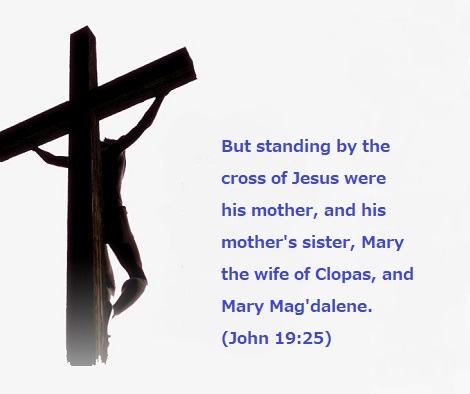
The Estuary of Theology 8 The Four People Standing Beside the Cross (Modified in Mar. 2020) I would like to resume the speculation I began in Issue 1 about the four people whom the heavenly Father drew to Jesus on the cross. I began it with looking into the scene of the crucifixion so that I could manage to approach the answer for the question why Christians are still not able to put an end to “the work of man.” It is because I took notice of the fact that John the Evangelist specified the people standing near the cross: the mother of Jesus, Mary the wife of Clopas, Mary of Magdalene and the disciple whom Jesus loved. The last four issues of this series were devoted to the discussions for proving that the Eucharist is eternal life. In these discussions, I dealt with the priesthood at the same time, which is inseparable from the Eucharist, and as a result, the purpose of Jesus on the cross in having made his beloved disciple take in his mother was made clear. It...